
Apply: UNESCO/Japan Young Researchers’ Fellowships Programme
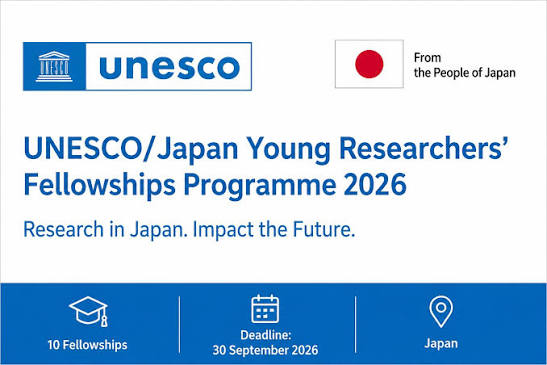
Established in 2001 under the Japanese Funds-in-Trust for the Capacity-Building of Human Resources, the UNESCO/Japan Young Researchers’ Fellowships Programme, also known as the UNESCO/Keizo Obuchi Research Fellowships Programme, is a long-standing initiative supported by the Government of Japan to strengthen research capacities and promote international knowledge exchange in areas aligned with UNESCO’s mandate. Since its establishment, the Programme has enabled 291 young researchers from 101 countries around the world to pursue postgraduate research, contributing to academic cooperation, capacity-building and the development of knowledge in fields of shared global importance.
Under the 2026 cycle, UNESCO and the Government of Japan will award 10 fellowships to highly qualified young researchers from Africa, Small Island Developing States, Ukraine and Türkiye. The fellowships will support innovative and high-quality postgraduate research related to heritage conservation and management, sustainable development and artificial intelligence, with particular attention to interdisciplinary research connecting these themes with social, ethical, governance and contextual dimensions.
Through research stays in Japanese universities and research institutions, fellows will have the opportunity to further develop their work and engage with Japan’s academic and research community.
| Key information | Details |
| Fellowships available | 10 |
| Fellowship grant | Up to US$10,000 |
| Duration | No less than 3 months and no more than 9 months |
| Host country | Japan |
| Fellowship period in Japan | From February 2027 onwards, to be completed no later than December 2027. |
| Application deadline | 30 September 2026, midnight Paris time |
| Submission channel | Through National Commissions for UNESCO |
Invited Member States and Associate Members
AFRICA – 47 Member States:
Angola, Benin, Botswana, Burkina Faso, Burundi, Cameroon, Cabo Verde, Central African Republic, Chad, Comoros, Congo, Cote d’Ivoire, Democratic Republic of the Congo, Djibouti, Equatorial Guinea, Eritrea, Eswatini, Ethiopia, Gabon, Gambia, Ghana, Guinea, Guinea-Bissau, Kenya, Lesotho, Liberia, Madagascar, Malawi, Mali, Mauritius, Mozambique, Namibia, Niger, Nigeria, Rwanda, Sao Tome and Principe, Senegal, Seychelles, Sierra Leone, Somalia, South Africa, South Sudan, Togo, Uganda, United Republic of Tanzania, Zambia, Zimbabwe
ARAB STATES – 1 Member State:
Bahrain
ASIA AND THE PACIFIC – 17 Member States, 2 Associate Members:
Cook Islands, Fiji, Kiribati, Maldives, Marshall Islands, Micronesia (Federated State of), Nauru, Niue, New Caledonia*, Palau, Papua New Guinea, Samoa, Singapore, Solomon Islands, Timor-Leste, Tokelau*, Tonga, Tuvalu, Vanuatu
LATIN AMERICA AND THE CARIBBEAN – 16 Member States, 7 Associate Members*:
Anguilla*, Antigua and Barbuda, Aruba*, Bahamas, Barbados, Belize, British Virgin Islands*, Cayman Islands*, Cuba, Curaçao*, Dominica, Dominican Republic, Grenada, Guyana, Haiti, Jamaica, Montserrat*, Saint Kitts and Nevis, Saint Lucia, Saint Vincent and the Grenadines, Sint Maarten*, Suriname, Trinidad and Tobago
EUROPE – 2 Member States:
Türkiye, Ukraine
Eligibility requirements
Applicants must:
- be nationals of one of the invited Member States or Associate Members listed in Annex 1;
- be no more than 40 years old at the time of application;
- hold at least a Master’s degree or equivalent in a field relevant to the proposed research and demonstrate strong academic and research potential;
- demonstrate sufficient proficiency in reading and writing in the language of instruction or supervision at the proposed host institution in Japan;
- have obtained acceptance from an academic supervisor at a Japanese university or research institution, who will oversee the proposed research.
Fellowship grant and eligible costs
Selected fellows may receive a fellowship grant of up to US$10,000. The grant will be provided as a lump-sum contribution and is intended to cover costs directly related to the approved research stay in Japan.
The grant may cover:
- international and domestic travel for the approved itinerary;
- accommodation;
- medical insurance;
- personal subsistence in Japan, including meals, local transportation and incidental expenses;
- other research-related expenses, where applicable.
The grant does not cover tuition fees, the purchase of equipment, including computers, publication costs or participation in conferences, unless such participation can be clearly justified as an integral part of the research and makes a direct and significant contribution to the project.
Medical insurance is mandatory for all selected fellows and will be arranged by UNESCO on their behalf. The cost of medical insurance will be deducted from the total fellowship amount before disbursement.
How to apply
Step 1:
Read carefully the Application Guide to understand the requirements for eligible candidatures and the procedures for the submission of application.
Step 2:
Contact the National Commission for UNESCO of your home country to enquire about the application procedures at the national level. Click here for the contact information of the National Commissions for UNESCO.
Step 3:
Prepare all required documents, including the application form (Annex 3), academic documents, recommendation letter, host institution acceptance letter, language certificate and research proposal (Annex 4).
Step 4:
Submit your application to the National Commission for UNESCO of your home country, at least 2 weeks before the required deadline.
Step 5:
As soon as you are informed by the National Commission for UNESCO of your country that you are nominated as a candidate for this programme, you should communicate your the online application form and the supporting documents to keizoobuchi.fellowships@unesco.org.
Note: Only applications nominated by the National Commission will be accepted by UNESCO.
Step 6:
Letters of nomination, along with all the application documents should be submitted to UNESCO by the National Commissions no later than 30 September 2026, midnight Paris time. Candidates who submit incomplete applications, or submit the online applications beyond this deadline won’t be considered.
Selection process
Applications will be evaluated by a Selection Committee composed of experts from UNESCO and the Government of Japan in the relevant fields. The evaluation will take into account the merits of the candidates and the quality, relevance and originality of their proposed research.
The final selection decision will be made by the Japanese authorities, based on the recommendation of the Committee, with due consideration to gender equality and diversity.